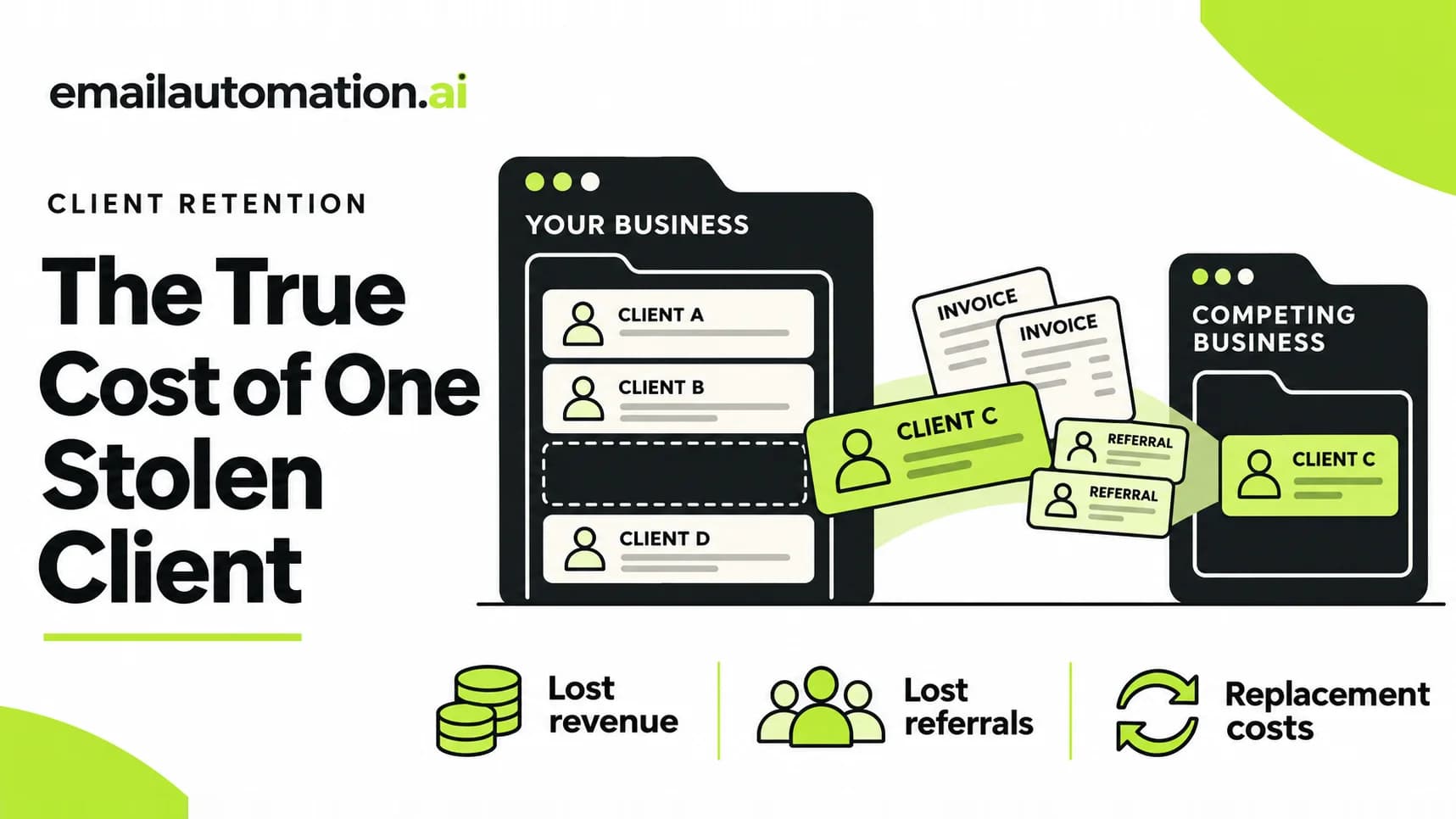




How would you know if one of your agents was quietly offering your clients a better deal somewhere else?
For most owners, the honest answer is that they wouldn't. Not until a client leaves. Sometimes not even until a whole group of them have gone.
Still, poaching tends to leave a trail behind. One odd thing on its own? Easy to shrug off. It's when you notice three or four of them at once that the picture changes.
Here are seven warning signs worth knowing. None of them proves anything by itself, so we'll also cover how to handle what you find without damaging trust on your team.
Signs You'll Notice in the Accounts
1. One person's accounts are going quiet
Every business loses clients now and then. What stands out is when the losses cluster around the same employee. Orders from their accounts shrink. Regular clients stop reordering. Renewals they were handling slip by with no clear reason.
A simple report by account owner, run every month or so, makes this easy to see. A drop that shows up across one person's book but nowhere else deserves a closer look.

2. Deals keep going to a mystery competitor
Your quote was fair, yet the client went with someone a little cheaper. The competitor's name never comes up. Sometimes it's a business nobody on your team has even heard of.
Once is normal. When it keeps happening on the same rep's deals, it's fair to wonder who that competitor really is.

3. Client conversations vanish from your systems
Open the email history and CRM notes for a rep's accounts. If they used to be full and now go weeks without a logged email or call, the conversations probably haven't stopped. They've moved somewhere you can't see, like a personal cell, text messages or WhatsApp.
Reps sometimes explain it as clients preferring to text. That may well be true. It still means you've lost sight of what's being said.

4. They guard "their" clients closely
Some reps don't like anyone else talking to the clients they handle. They leave managers off email threads, push back on shared accounts and get tense when a colleague picks up one of their calls.
A bit of ownership is healthy and often a sign of a good rep. Blocking every handover or joint meeting is different. That rep may have a reason to keep you at a distance.

Signs in Behavior and Data
5. Interest in data outside their normal work
Watch for requests or access that don't fit someone's role. A rep who suddenly wants pricing for accounts they don't handle. An export of the full client list that nobody asked for. Logins late at night or over the weekend with no deadline to explain them.
This kind of activity tends to show up in the weeks before a resignation. We walked through a real case of it in our post on how employees steal clients.

6. Changes in how a group behaves
Team moves have their own pattern. A legal Q&A in Personnel Today, written by lawyers at Stephenson Harwood, lists several things to watch for. Offsite group meetings, unusual absences or travel, colleagues who suddenly grow close and brand new email groups all made their list (Personnel Today).
The same lawyers point out that junior staff often resign first. People with short notice periods and no restrictive clauses can leave early and start setting things up before the senior people follow. Someone keen to cut their notice period short might have a competitor waiting for them, too.

7. A client mentions an unexpected call
Now and then your clients tell you before anyone inside does. One might mention, almost in passing, that your old salesperson reached out last week. Someone else asks if you're still taking orders. Apparently they'd heard you were shutting down.
Don't brush off comments like that. Jot each one down with the date, even if it seems minor at the time. Three notes over two months tell you a lot more than a vague memory ever will.

A Warning Sign Isn't Proof
Here's the tricky part. Every single item above has a perfectly innocent explanation. Sales dip. Plenty of clients honestly would rather text. Your best people usually care a lot about the accounts they've built up. If you jump on one sign as proof, you risk losing a good employee. The rest of the team will notice how you handled it, too.
So go slowly. A few habits help:
- Wait for a pattern. One sign is a hunch, while three or four start to mean something.
- Write things down as they happen, dates included. Memory gets fuzzy fast.
- Talk to HR or a lawyer before you say a word to the employee.
- Know your state's monitoring rules. Some states require notice first. In New York, for instance, private employers have had to give written notice of phone, email and internet monitoring since May 2022 (Hunton Andrews Kurth).

What to Do When the Signs Add Up
Start with your clients rather than the employee. Call your key accounts yourself just to check in. People tend to mention things on a friendly call that they'd never put in an email. Hearing from you directly also reminds them whose company they're actually dealing with.
After that, tighten access quietly. Who on your team can export the full client list? Does everyone really need the permissions they have? If someone resigned tomorrow, how long would it take to lock them out? Fix whatever those answers turn up. And if it looks like a contract has been broken, get an employment lawyer involved before you do anything about it.
All of this gets a lot harder when your team talks to clients from their own phones and inboxes, since you can't check what you can't see. With emailautomation.ai, client emails and calls run through one shared platform instead. Agents never see client addresses or phone numbers, so there's far less for them to walk off with. You set access by role and decide exactly who sees what. Fewer openings means less time spent hunting for warning signs in the first place.

Spotting It Late Still Costs You
By the time warning signs show up, something has usually started already. You'll get much further by making poaching hard to do from day one.
See how your team works when client contact details stay private. Try emailautomation.ai free. If a quick tour sounds better, book a demo with our team.

Frequently Asked Questions
What are the signs an employee is stealing clients?
Look out for one rep's accounts slowing down, deals going to a competitor nobody can name and client chats moving off your systems. Big data exports matter too, as do clients mentioning a call from a former colleague. Any one of these could be nothing. Several at the same time are worth taking seriously.
Is it a good idea to confront a rep I think is poaching clients?
Not yet. Get your facts in order and bring in HR or an employment lawyer first. Accusing someone too early can land you in legal trouble. Your team won't forget it either.
Am I allowed to read employee emails to look for poaching?
On company systems, generally yes, though the rules vary by state. In New York you have to tell employees in writing before any electronic monitoring starts. A quick check with a lawyer will tell you what applies where you are.
A client says my former employee called them. Now what?
First, thank them for telling you. Note the date and anything they're happy to share. If they're open to it, ask them to forward any messages they received. A lawyer can then look at whether the former employee broke an agreement.

Sources
- Legal Q&A: Protecting a business against staff and client poaching, Personnel Today, February 2010
- New York State Requires Private Employers to Notify Employees of Electronic Monitoring, Hunton Andrews Kurth, November 2021
Ready to put AI to work on your emails?
Talk to AI Email Automation about your campaigns.