
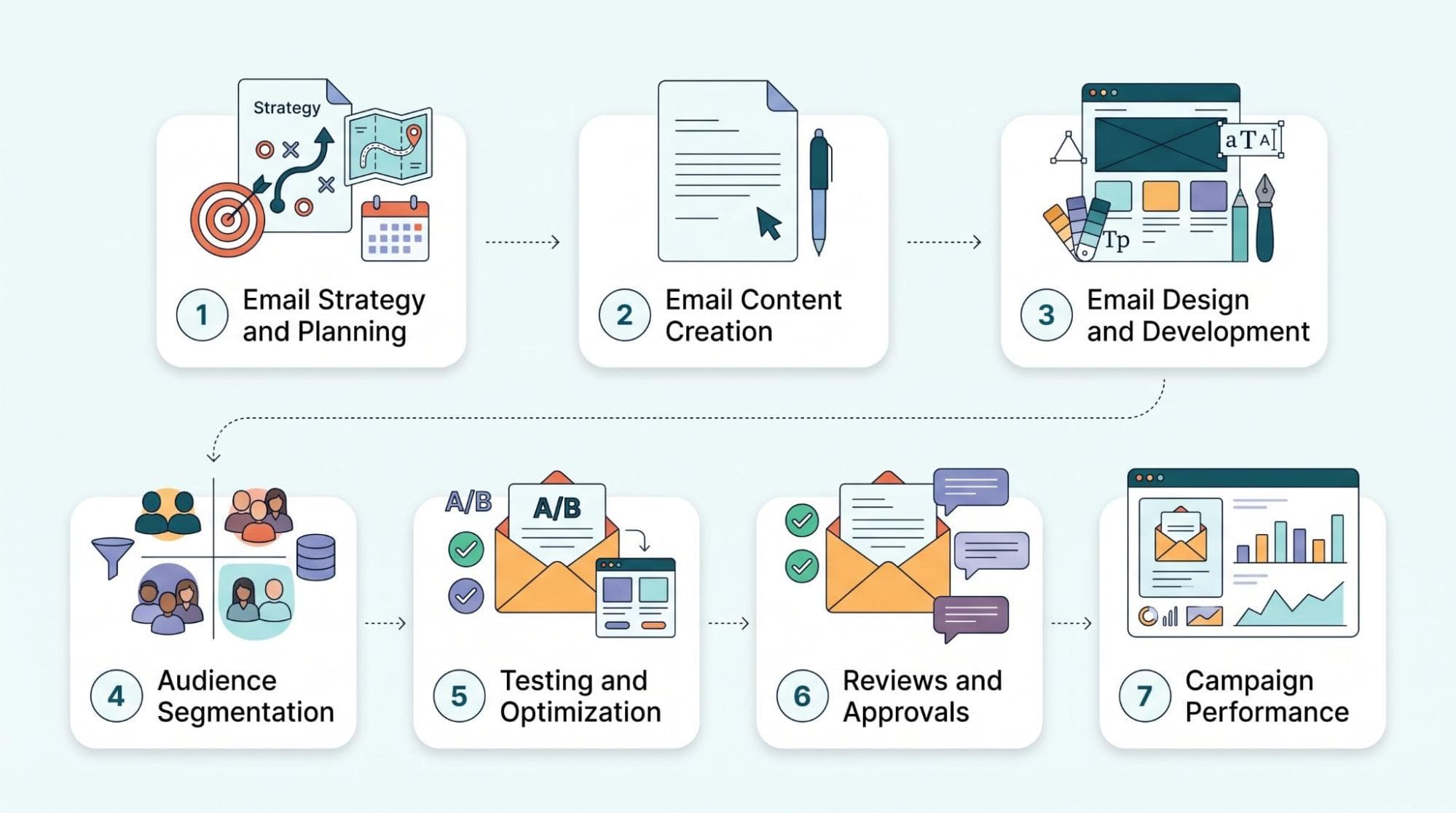
Email marketing involves strategy, writing, design, coding, testing, approvals, delivery and performance analysis. Managing each stage manually takes time and creates delays between teams.
An AI email workflow reduces repetitive work and connects important campaign tasks. It helps marketers work faster while keeping people responsible for strategy, creativity and final decisions.
1What Is an AI Powered Email Workflow?
An AI powered email workflow uses artificial intelligence to support campaign planning, production, delivery and analysis. It combines AI email marketing tools with existing email automation systems and team processes. AI can organize information, prepare suggestions and complete routine checks within seconds.
AI is also more than an email copywriting tool. It can support segmentation, personalization, coding, testing, approvals and campaign analysis. AI Email Automation works best when it improves the complete process instead of handling only content creation.
2How Can AI Simplify the Email Workflow?
AI connects separate campaign activities and reduces unnecessary manual steps. It can prepare content options, examine subscriber data and identify errors before an email reaches customers.
“Litmus reported that “62 percent of email teams needed at least two weeks to produce one email during 2024. That number fell to only 6 percent in 2025” as AI and automation changed production processes.
2.1. Use AI for Email Strategy and Planning
AI can review previous campaigns, customer questions, browsing activity and subscriber interests during the planning stage. This information helps marketers create campaign ideas based on real audience needs.
Teams can use AI to outline welcome sequences, product education campaigns, abandoned cart messages and customer retention emails. Predictive analytics can also identify topics or offers that performed well among similar subscribers. Marketers must confirm that every idea matches campaign goals, customer expectations and the wider marketing lifecycle.
2.2. Speed Up Email Content Creation
Generative AI can suggest subject lines, preview text, headings, calls to action and complete email drafts. It can also shorten copy, improve clarity or adjust the tone for different audiences. Clear instructions help AI email copywriting tools produce content that reflects the campaign purpose. Approved brand examples can further improve tone and maintain a recognizable AI brand voice.
Writers should verify every claim and remove generic or repeated language before approval. AI generated email content still needs human editing to sound natural, accurate and useful. Litmus found that generative AI tools created the greatest impact for 25 percent of surveyed email marketers. Personalization followed at 18 percent, while campaign analysis reached 16 percent.
2.3. Simplify Email Design and Development
AI email design tools can suggest layouts, images, content blocks and visual order based on campaign requirements. Reusable email templates prevent designers from rebuilding the same structure for every message. A modular email design system includes approved headers, product sections, buttons and footers. Teams can rearrange these components while preserving colors, fonts, spacing and email brand consistency.
AI can also generate basic email code, update repeated sections and identify common coding errors. However, developers must test responsive layouts, accessibility, dark mode and email rendering across different inbox providers. Only 28 percent of companies in the Litmus research used a centralized template system for brand consistency. This suggests many teams can still improve production through reusable designs.
2.4. Improve Audience Segmentation and Personalization
AI audience segmentation examines subscriber data, purchase history, browsing behavior and previous email engagement. It can organize customers into groups with similar needs, interests or lifecycle stages. Marketers can then deliver dynamic email content based on customer preferences and recent activity. AI hyper personalization may recommend different products, educational resources or offers for individual subscribers.
Businesses must handle first party email data carefully and follow applicable privacy requirements. Personalization should feel helpful and relevant, never intrusive or based on information customers did not knowingly provide.
2.5. Make Testing and Optimization Easier
AI A/B testing can compare subject lines, layouts, content order and calls to action. It helps marketers identify meaningful differences across campaign versions and audience groups. AI send time optimization uses earlier engagement patterns to recommend suitable delivery periods. Teams should still consider time zones, message urgency and communication frequency before following these suggestions.
Email QA should also cover working links, tracking codes, spelling, accessibility and mobile display. Human review remains necessary because automated tools may miss context or uncommon rendering problems.
2.6. Speed Up Email Reviews and Approvals
AI email approvals can collect feedback, group repeated comments and identify unresolved issues. Automated checks may also find grammar errors, missing links, outdated disclaimers and inconsistent brand terms. Reviewers should have clearly defined responsibilities before the campaign reaches the approval stage.
This prevents minor feedback from restarting strategy, design or development without a valid reason. AI Email Automation can record completed checks and notify the right person when approval becomes necessary. People should always approve legal language, sensitive claims, prices and major creative decisions.
2.7. Analyze Email Campaign Performance
AI email analytics can examine clicks, conversions, unsubscribes, delivery issues and other useful engagement measures. It can compare results across segments, campaign types and customer journey stages.
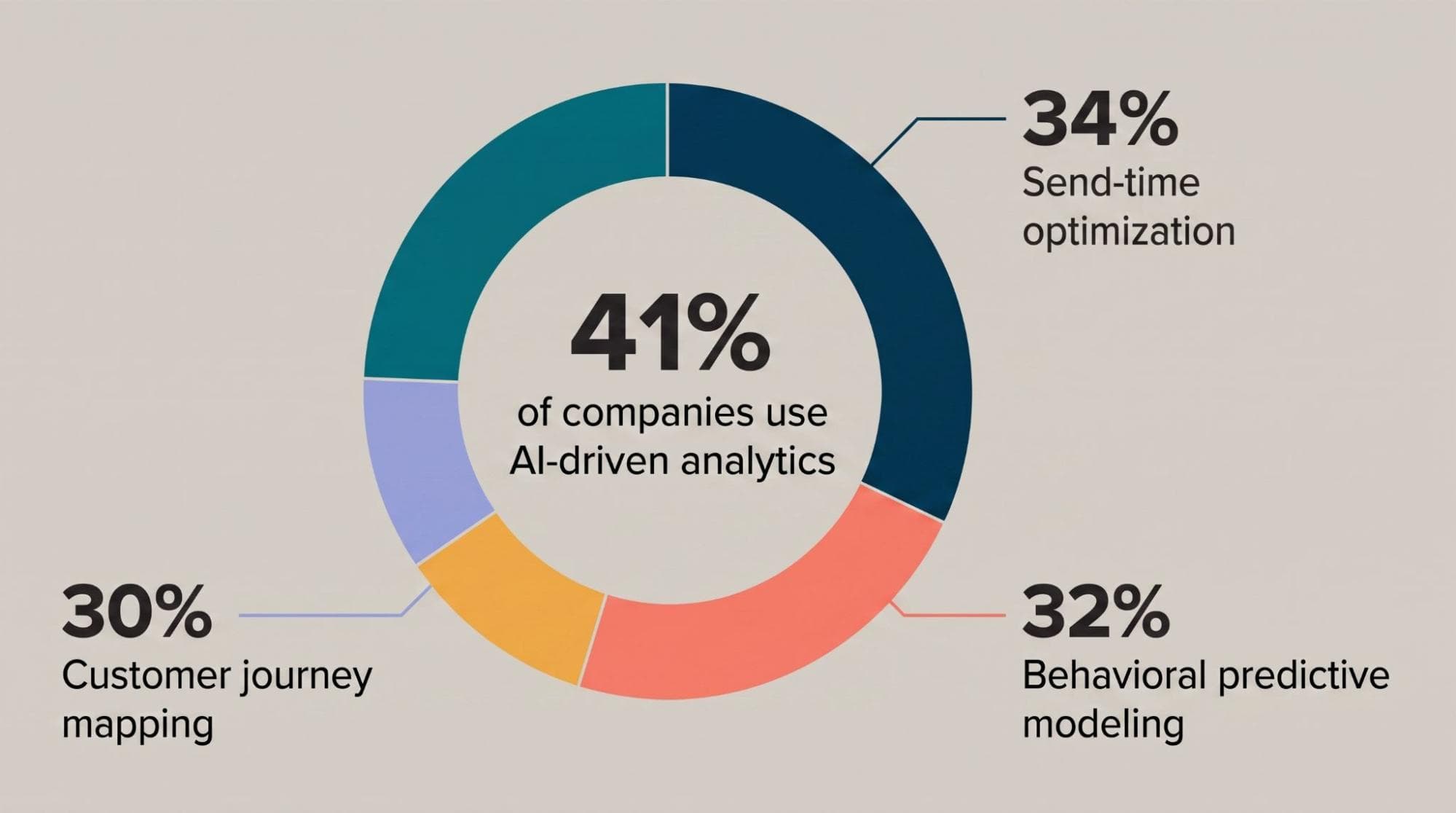
“Litmus found that “at least 41 percent of companies use some form of AI driven analytics.” Common applications include send time optimization at 34 percent, behavioral predictive modeling at 32 percent and customer journey mapping at 30 percent.
Marketers should connect engagement with leads, sales, retention and customer value. This approach provides a more accurate view of email marketing ROI than isolated campaign metrics.
3Benefits of Using AI in Email Workflows
AI offers practical benefits across the complete email marketing workflow:
- Saves time by completing repeated research, editing, testing and reporting tasks.
- Supports faster campaign production without removing necessary quality checks.
- Improves personalization by analyzing customer and behavioral email data.
- Reduces manual work across content, design, development and campaign management.
- Helps marketers find useful patterns within large performance reports.
- Maintains consistency through approved templates, rules and brand guidance.
- Gives teams more time for strategy, creativity and subscriber research.
4Limitations of AI in Email Marketing
AI also introduces some limitations that require careful management:
- Generated content may include incorrect information or generic wording.
- Brand voice can become inconsistent without shared instructions and examples.
- Customer data requires secure storage, controlled access and responsible use.
- Generated code may fail across certain devices or email applications.
- Predictive recommendations may reflect incomplete or unreliable historical data.
- Automated personalization can feel intrusive when teams use excessive customer information.
- Human strategy, creativity and final approval remain essential.
5How to Add AI to Your Existing Email Workflow
Businesses can introduce AI gradually instead of changing the complete workflow immediately. So here is the flow you can use to connect with an existing automation system:
- 1Map each campaign stage and identify repetitive tasks causing production delays.
- 2Choose AI email marketing tools that connect with existing automation systems.
- 3Begin with one task, such as editing, reporting or subject line generation.
- 4Create clear rules for brand voice, customer data and human review.
- 5Compare production time, accuracy and campaign performance with previous results.
- 6Correct problems before applying AI to additional workflow stages.
- 7Train team members to review AI output instead of accepting it automatically.
6The Future of AI in Email Marketing
“Litmus found that “70 percent of marketers expect AI to support up to half their email operations by late 2026.” Another 18 percent expect AI involvement across 50 to 75 percent of their email work.
Future tools may connect content, audience selection, delivery timing and campaign analysis within one process. More advanced personalization and predictive analytics could also improve customer relevance.
7Contact Us to Build a Smarter Email Workflow
The right workflow combines automation with human strategy, creative thinking and careful quality control. Contact AI Email Automation to explore practical ways of simplifying campaign planning, production, testing and analysis while maintaining brand consistency and subscriber trust.
Ready to simplify your email workflow?
Talk to AI Email Automation about your campaign process.