Customers expect brands to understand their needs. They want useful product suggestions, relevant emails and timely offers. Traditional personalization helps businesses meet some of these expectations. However, it often relies on fixed rules, broad customer groups and manually created workflows.
Agentic personalization offers a more flexible approach. It uses autonomous AI agents to study customer behavior, make decisions and take approved actions. The system can change content, timing, offers and customer journeys as new information becomes available.
This guide explains agentic personalization, how it works and how businesses can use it across email and other marketing channels.
What Is Agentic Personalization?
Agentic personalization is the use of autonomous AI agents to create and adjust individual customer experiences in real time. These agents analyze customer data, understand intent and choose actions that support a defined business goal.
Traditional personalization usually places customers into groups. For example, a retailer may send one email to new customers and another to returning customers. Every person in each group receives a similar experience.
Agentic personalization can make decisions for each customer. It may select a different message, product, offer and sending time based on that person’s current behavior.
The system does more than follow fixed instructions. It observes what happens, evaluates the result and adjusts its next action. This continuous process creates more responsive customer journeys.
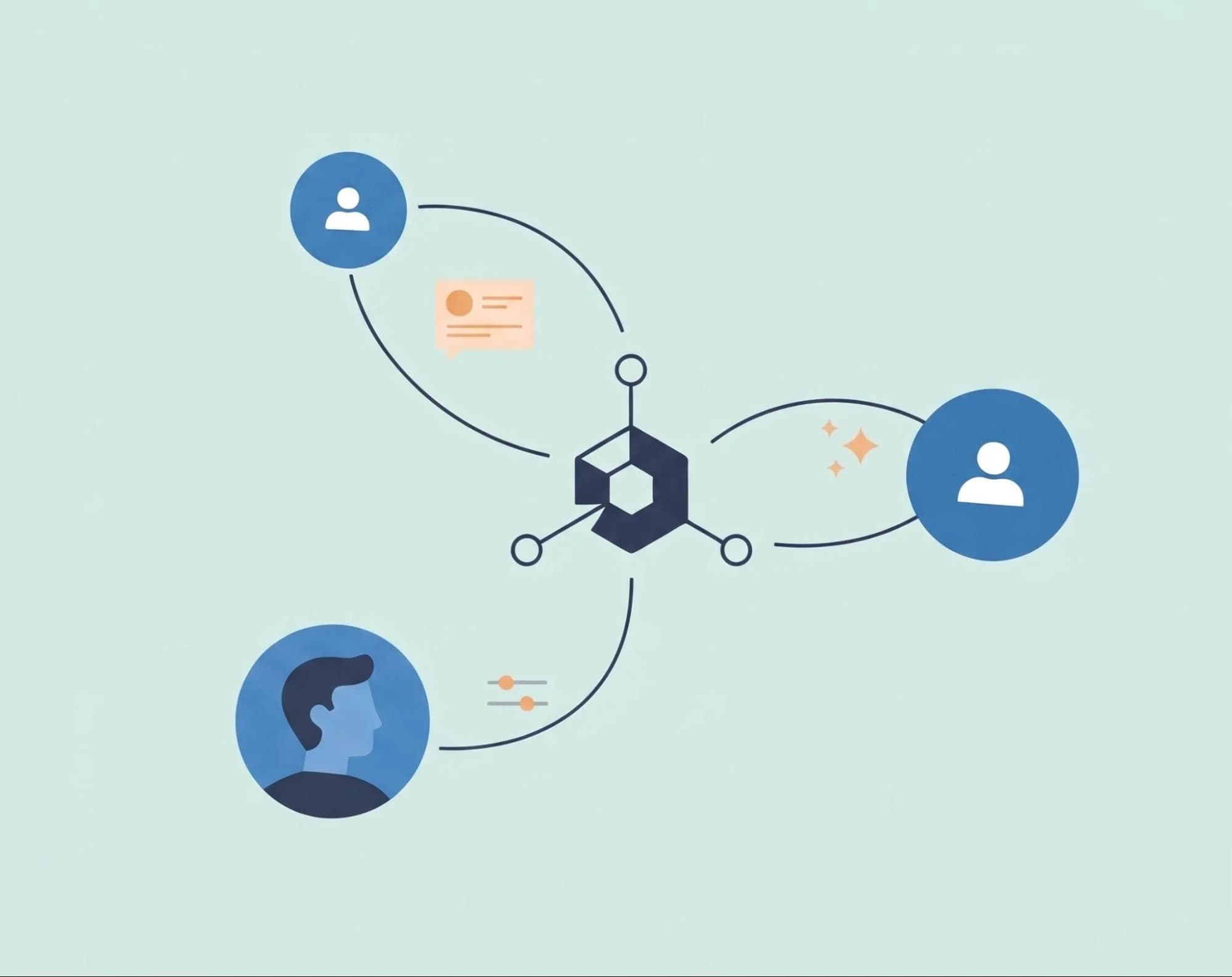
A Simple Agentic Personalization Example
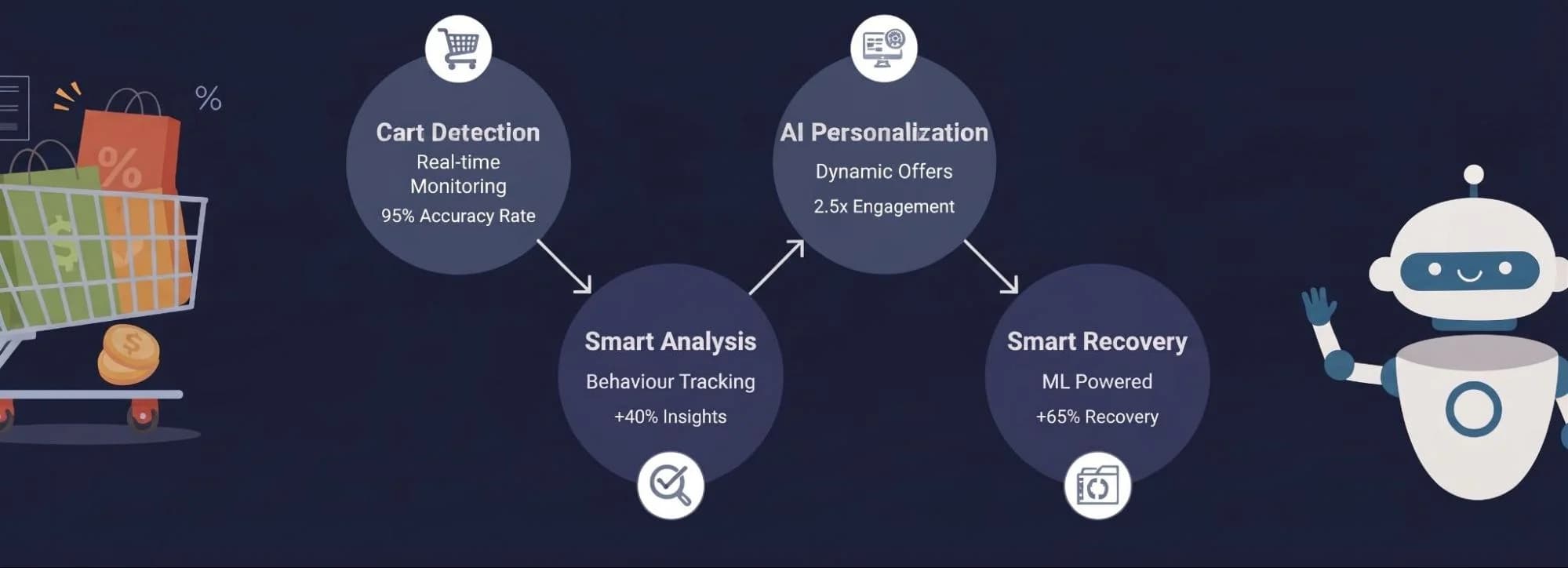
Consider two customers who leave the same product in their carts.
A traditional abandoned cart workflow may send both customers the same reminder after two hours. It may send another email the following day with a standard discount.
An agentic system can treat each customer differently.
The first customer regularly buys without discounts. The AI agent may send a simple reminder when that customer usually checks email.
The second customer often compares prices and purchases during sales. The agent may wait longer and include a suitable incentive.
If either customer completes the purchase, the system stops the recovery emails. It can then choose a relevant follow up message based on the purchased product.
What Is Agentic AI?
Agentic AI refers to artificial intelligence systems that can work toward a goal with a degree of independence. These systems can study information, plan actions, use available tools and adjust their approach based on results.
A traditional AI tool usually responds to a direct request. You give it a prompt and it produces an answer.
An AI agent can handle a wider process. It can decide which action should happen next within the limits set by a business.
Agentic AI systems usually have several important qualities:
- Goal based behavior: The system works toward a clear result such as improving conversions or retaining customers.
- Autonomy: It can make approved decisions without waiting for a new instruction each time.
- Context awareness: It considers customer history, current activity and business conditions.
- Adaptability: It changes its decisions when new information becomes available.
- Planning: It can divide a larger goal into smaller actions.
- Continuous learning: It uses results from previous actions to improve later decisions.
Businesses must still define goals, permissions and safety limits. Agentic AI should not have unlimited authority over customer data or marketing decisions.
How Does Agentic Personalization Work?
Agentic personalization connects customer data with AI models, marketing platforms and business rules. The exact process depends on the company and its technology. Most systems follow several common stages.
1. The System Collects Customer Data
The AI agent needs reliable information to understand the customer. This data may come from:
- Website visits
- Email opens and clicks
- Purchase history
- Product searches
- Shopping cart activity
- Customer support conversations
- CRM records
- Mobile app activity
- Communication preferences
- Loyalty program activity
The system can combine historical information with current behavior. For example, it may consider a customer’s past purchases and the products they viewed today.
Businesses should only collect and use data with proper consent. They must also follow relevant privacy requirements.
2. It Interprets Customer Intent
A list of customer actions does not always explain what someone wants. Agentic personalization tries to understand the meaning behind those actions.
A customer who repeatedly views the same product may be close to purchasing. Another person may visit several educational pages because they are still researching.
The agent considers these patterns before choosing a response. This helps it avoid sending the same message to customers with different needs.
3. It Works Toward a Defined Goal
Every AI agent needs a clear objective. A business may ask the system to:
- Increase email engagement
- Convert more leads
- Recover abandoned carts
- Improve repeat purchases
- Reduce customer churn
- Increase average order value
- Help customers find suitable products
The goal guides the agent’s decisions. Clear goals also make performance easier to measure.
4. It Selects the Next Best Action
The agent evaluates possible actions and selects the one most likely to support its goal.
It may decide:
- Which customer should receive a message
- Which product to recommend
- What type of content to show
- When to send an email
- Whether to offer a discount
- Which communication channel to use
- When to stop or change a campaign
These choices depend on customer context, business rules and expected results.
5. It Carries Out the Action
The AI agent connects with email platforms, CRM systems, ecommerce stores and other approved tools. It then performs the selected action.
For example, it may create a customer segment, select an email template and insert relevant product recommendations. It can then schedule the email for the time when that recipient is most likely to engage.
6. It Learns From the Outcome
The agent monitors what happens after each action. It may track whether the customer opened an email, clicked a link, viewed a product or completed a purchase.
That response becomes new information. The agent uses it to improve the next decision.
This feedback process allows customer journeys to change over time instead of following one fixed path.
Agentic Personalization vs Traditional Personalization
Both approaches aim to make customer experiences more relevant. The main difference lies in how they make and update decisions.
| Feature | Traditional Personalization | Agentic Personalization |
|---|---|---|
| Decision process | Uses fixed rules | Makes goal based decisions |
| Customer targeting | Relies on broad segments | Uses individual customer context |
| Data | Often uses stored data | Uses historical and real time data |
| Campaign structure | Follows preset workflows | Adapts journeys as behavior changes |
| Content | Uses predetermined versions | Selects or creates suitable content |
| Timing | Uses scheduled delivery | Can choose timing for each person |
| Testing | Requires manual setup | Can optimize approved elements continuously |
| Learning | Depends on marketer analysis | Uses ongoing feedback |
| Channel management | Often separates channels | Can coordinate actions across channels |
| Human involvement | Requires regular manual changes | Automates approved decisions |
Traditional personalization still works well for simple and predictable campaigns. Agentic personalization becomes more valuable when customer behavior changes quickly or when a business manages many products, audiences and journeys.
Agentic Personalization vs Generative AI
Generative AI and agentic AI perform different roles.
Generative AI creates content. It can write an email subject line, produce product copy or generate an image from a prompt.
Agentic AI decides what needs to happen. It can select the customer, identify the purpose of the message and choose the best time to send it. It may use generative AI to create the content.
Consider an email campaign. A generative AI tool might write five subject lines when a marketer requests them. An AI agent can decide which customer needs an email, choose an approved subject line and schedule the message. It can then evaluate the response and adjust the next email.
These technologies often work together. Generative AI produces material while agentic AI manages decisions and actions.
Agentic Personalization vs Predictive Personalization
Predictive personalization uses historical data to estimate what a customer may do next. It can predict the chance of a purchase, cancellation or response to an offer.
Agentic personalization can use these predictions to take action.
For example, a predictive model may identify a customer with a high risk of leaving. An AI agent can use that prediction along with recent activity and communication preferences. It may then select a retention message or send the case to a human team member.
Prediction provides an estimate. An agentic system uses information to decide and act.
Agentic Personalization vs Hyper Personalization
Hyper personalization describes the depth of a personalized experience. It combines detailed customer data with real time signals to deliver highly relevant content or recommendations.
Agentic personalization describes how the system makes decisions. Autonomous agents analyze context, choose actions and improve those actions over time.
An agentic system can produce hyper personalized experiences. However, the two terms do not mean exactly the same thing.
Key Benefits of Agentic Personalization
Agentic personalization can help businesses improve customer communication and reduce repetitive work. The results depend on data quality, system design and responsible use.
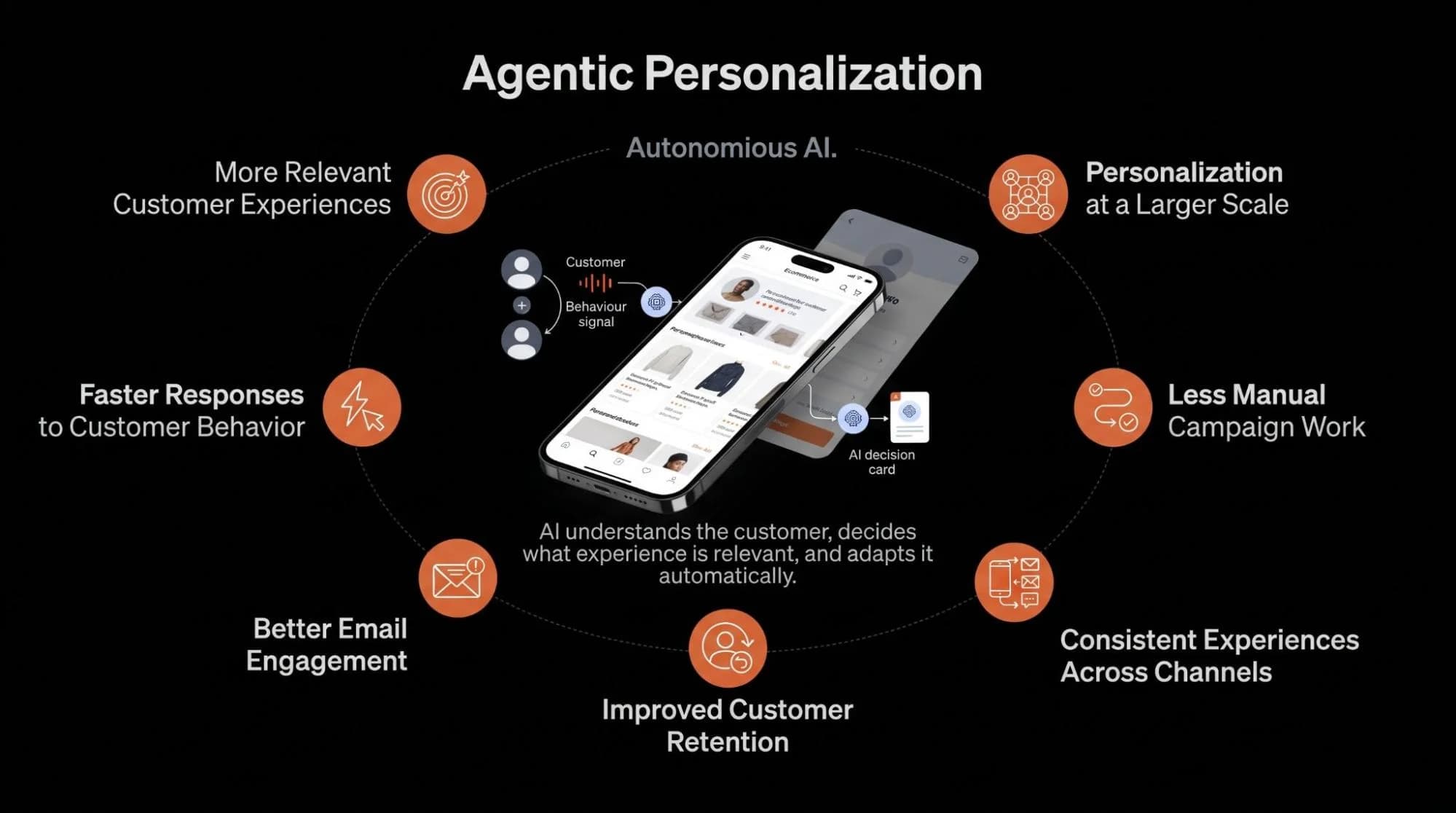
More Relevant Customer Experiences
Customers do not follow identical paths. Some need more information while others are ready to buy. Agentic personalization responds to these differences.
The system can adjust content according to current interests, previous activity and purchase stage. This makes each interaction more useful.
Personalization at a Larger Scale
Manual personalization becomes difficult when a business has thousands of customers and products. Marketers cannot build a separate journey for every person.
AI agents can evaluate many customer signals and make individual decisions at scale. Teams can focus on strategy, creative direction and quality control.
Faster Responses to Customer Behavior
Customer intent can change quickly. Someone who viewed a product yesterday may purchase it today or lose interest tomorrow.
An agentic system can respond while the activity remains relevant. It can change a recommendation, stop an unnecessary reminder or send useful information at the right moment.
Less Manual Campaign Work
Traditional automation requires marketers to create segments, triggers and branches. Large campaigns can become difficult to manage.
AI agents can automate approved tasks such as audience selection, send time optimization and journey adjustment. This reduces routine work without removing human oversight.
Better Email Engagement
Relevant emails give recipients a stronger reason to open and click. Agentic personalization can adjust subject lines, content, timing and frequency for each person.
It can also avoid messages that no longer match the customer’s situation. For example, the system should stop promoting a product after the customer has purchased it.
Improved Customer Retention
Customers are more likely to remain engaged when a business provides useful communication. AI agents can notice declining activity and choose an appropriate response.
The system may offer support, recommend relevant products or reduce message frequency. The best action depends on the customer’s history and current behavior.
Consistent Experiences Across Channels
Customers may interact with a brand through email, a website, an app and customer support. Separate systems can create conflicting experiences.
An agentic system can coordinate these interactions. A customer who declined an offer in an email should not immediately see the same promotion everywhere else.
Agentic Personalization in Email Marketing
Email provides one of the clearest uses for agentic personalization. Businesses already collect useful signals through opens, clicks, purchases and website activity.
With AI Email Automation, businesses can learn how artificial intelligence supports smarter email workflows, content creation and campaign optimization.
Individual Send Time Optimization
A fixed campaign sends every email at the same time. However, recipients have different routines.
An AI agent can study when each person usually opens and clicks emails. It can then choose a suitable delivery time for that recipient.
Dynamic Email Content
Customers may receive different content within the same campaign. The agent can select:
- Product recommendations
- Images
- Educational content
- Discounts
- Calls to action
- Customer reviews
- Local store information
Each version should follow approved brand and content rules.
Adaptive Email Journeys
Traditional email sequences follow preset steps. A welcome series may send the same three emails to every subscriber.
An adaptive journey changes according to customer behavior. Someone who purchases after the first email can leave the welcome sequence and enter a post purchase journey. A person who reads several guides may receive more educational content before seeing an offer.
Autonomous Audience Segmentation
Customer segments can become outdated quickly. An AI agent can update groups as behavior changes.
A customer may move from a research group to a high intent group after viewing prices and returning to the same product several times.
Email Frequency Optimization
Sending too many messages may cause fatigue and unsubscribes. Sending too few may allow opportunities to disappear.
An AI agent can study individual engagement and adjust frequency. Active subscribers may receive more useful updates while less engaged recipients receive fewer messages.
Continuous Email Testing
AI agents can test approved subject lines, content blocks, offers and delivery times. They can monitor results and direct more traffic toward stronger variations.
Human teams should still set limits and review important changes. Testing should support customer value rather than simply increase message volume.
Practical Agentic Personalization Use Cases
Welcome Campaigns
The agent can adapt onboarding emails according to the subscriber’s source, interests and first actions. A person who joined through a product page may receive different information from someone who downloaded a guide.
Abandoned Cart Recovery
The system can choose when to send a reminder and whether an incentive is necessary. It can also select related information such as delivery details, customer reviews or product benefits.
Lead Nurturing
B2B leads often need different information before making a decision. An agent can study page visits, email engagement and form responses. It may then provide a guide, case study or sales invitation based on buying readiness.
Product Recommendations
Recommendations can reflect recent browsing, previous purchases, availability and customer preferences. The system can remove unavailable products and avoid suggesting items the customer already owns.
Replenishment Reminders
An agent can estimate when a customer may need to reorder a product. It can adjust the reminder based on normal use, purchase quantity and previous ordering patterns.
Customer Retention
A drop in engagement may signal that a customer is losing interest. The agent can change content, reduce email frequency or provide support before the customer leaves.
Reengagement Campaigns
Inactive customers should not all receive the same message. One customer may respond to new products while another may need account assistance. The agent can select an approach based on previous behavior.
Upselling and Cross Selling
AI agents can recommend useful additions after a purchase. A relevant suggestion supports the customer’s main purchase instead of promoting an unrelated product.
Applications Beyond Email
Agentic personalization can also support other areas of the customer experience.
Website Personalization
The system can adjust banners, products, calls to action and educational content according to visitor intent.
Ecommerce Search
An AI agent can interpret a search query and arrange results around individual preferences, product availability and current behavior.
Conversational Shopping
Shopping agents can answer product questions, compare choices and recommend suitable items. They can also use customer context when the customer has given permission.
Mobile Apps
Businesses can personalize app content, notifications and offers. The system can adjust these interactions based on recent app and purchase activity.
Customer Support
An agent can identify likely problems and recommend solutions. High risk or sensitive issues should move to a qualified human representative.
Digital Advertising
AI agents can adjust audiences, messages and approved campaign settings. Businesses should set clear spending limits and monitor every automated change.
What Data Does Agentic Personalization Need?
Agentic personalization does not simply need more data. It needs accurate, connected and relevant data.
Important data types include:
- Zero party data: Information customers intentionally share such as preferences and interests.
- First party data: Information collected through direct interactions with the business.
- Behavioral data: Page views, clicks, searches and browsing activity.
- Transactional data: Purchases, refunds, subscriptions and order values.
- CRM data: Lead status, customer history and account details.
- Email data: Opens, clicks, replies and unsubscribes.
- Contextual data: Device, time, location and current session activity.
- Product data: Prices, features, stock levels and product relationships.
Connected data prevents poor decisions. An email agent should know when a customer has already purchased, requested support or changed communication preferences.
Technology Behind Agentic Personalization
Several technologies work together to support agentic experiences.
AI agents manage goals, decisions and actions. Machine learning models identify patterns and estimate likely outcomes. Large language models can understand requests and create natural content.
A customer data platform may combine information from different sources. CRM software stores customer and lead records. Marketing automation platforms deliver messages and track engagement.
APIs allow these systems to exchange information. Real time analytics help the agent evaluate results and adjust its actions.
A business does not always need every type of software. The required technology depends on its goals, customer volume and existing systems.
How to Implement Agentic Personalization
A controlled implementation reduces risk and makes results easier to evaluate.
Step 1: Define One Clear Goal
Start with a measurable business problem. You may want to improve cart recovery, increase repeat purchases or reduce email campaign setup time.
A broad goal such as “improve personalization” does not give the agent enough direction.
Step 2: Choose a Focused Use Case
Select one journey with enough data and a clear result. Abandoned cart emails, welcome campaigns and lead nurturing are practical starting points.
Step 3: Review Your Customer Data
Check whether your data is accurate, current and properly connected. Remove duplicates and correct obvious errors.
You must also confirm that your data collection and use follow customer consent and applicable privacy requirements.
Step 4: Connect Essential Platforms
The agent may need controlled access to your email platform, CRM, website, analytics and ecommerce system.
Only provide the access required for the chosen use case.
Step 5: Set Rules and Guardrails
Define what the agent can and cannot do. Guardrails may include:
- Approved content and offers
- Maximum discount limits
- Brand voice requirements
- Email frequency limits
- Data access controls
- Spending limits
- Required human approvals
- Escalation conditions
These controls protect customers and the business.
Step 6: Begin With Limited Autonomy
Allow the agent to handle low risk decisions first. It may recommend actions before receiving permission to carry them out.
Expand its authority only after testing accuracy and reliability.
Step 7: Test the Complete Experience
Review the messages customers receive. Check the content, timing, product information and journey logic.
Testing should include unusual situations such as refunds, out of stock products and repeated purchases.
Step 8: Compare Performance
Use a control group or compare results with the previous workflow. Track business results and negative signals such as complaints or unsubscribes.
Step 9: Expand Carefully
If the first use case performs well, apply the system to another campaign or channel. Continue monitoring decisions as the scope grows.
Challenges and Risks
Agentic personalization offers useful capabilities but it also creates important responsibilities.
Customer Privacy
The system may process detailed customer information. Businesses must collect data lawfully, explain its use and honor customer preferences.
Poor Data Quality
Incorrect or incomplete data produces weak decisions. A mistaken purchase record may cause the agent to recommend an irrelevant product or send the wrong message.
Lack of Transparency
Teams should understand why the system made an important decision. Clear records help marketers review actions and correct problems.
Excessive Automation
Some decisions require human judgment. Sensitive support cases, unusual discounts and regulated communications should have suitable approval steps.
Brand Inconsistency
Generated messages may drift from the approved brand voice. Businesses need content rules, templates and regular reviews.
Customer Discomfort
Personalization can feel intrusive when it reveals too much knowledge about a person. Brands should use customer data to provide value without making people feel watched.
Bias and Incorrect Decisions
AI models can produce unfair or inaccurate results. Regular testing helps identify problems across different customer groups.
Difficult Integrations
Disconnected platforms may provide incomplete customer context. The agent cannot make reliable decisions when important systems fail to share updated information.
Best Practices for Responsible Use
Businesses can reduce risk by following clear operating standards:
- Use customer data with valid consent.
- Give every agent a specific goal.
- Limit access to necessary systems and information.
- Define approved actions and restricted actions.
- Keep humans involved in sensitive decisions.
- Record important automated actions.
- Review generated content regularly.
- Monitor errors and unusual behavior.
- Test outcomes across different customer groups.
- Make communication preferences easy to change.
- Stop automated actions when data becomes unreliable.
- Protect customer information with suitable security controls.
Customer value should guide every decision. More personalization does not always create a better experience.
How to Measure Agentic Personalization
Measurement should cover revenue, engagement, customer experience and operational performance.
Useful metrics include:
- Email open rate
- Click through rate
- Conversion rate
- Revenue per email
- Cart recovery rate
- Average order value
- Repeat purchase rate
- Customer retention rate
- Customer lifetime value
- Unsubscribe rate
- Complaint rate
- Time saved through automation
- Cost per conversion
- Number of automated decisions
- Number of decisions requiring human review
- Error and correction rate
Do not judge performance through a single metric. A campaign may increase clicks while also increasing unsubscribes. The complete result matters.
Is Agentic Personalization Right for Your Business?
Agentic personalization may be suitable if your business has:
- Reliable customer data
- Connected marketing systems
- Several customer journeys
- Enough customer activity to identify patterns
- Clear marketing goals
- Repetitive campaign management tasks
- A team that can monitor automated decisions
- Defined privacy and approval policies
A small business can still use agentic personalization. It does not need to automate every customer interaction. A focused email use case may provide a practical starting point.
Companies with poor data or disconnected systems should address those problems first. Adding an AI agent will not correct an unreliable foundation.
The Future of Agentic Personalization
Agentic personalization will likely move marketing away from fixed campaigns and toward adaptive customer journeys. Email sequences may respond to individual behavior instead of following predetermined schedules.
Marketing channels may also become more connected. An agent could coordinate email, website content and support interactions around one customer goal.
Human involvement will remain important. Marketers will define strategy, approve creative standards and manage risk. AI agents will handle more of the analysis and routine decisions within those limits.
Privacy, transparency and customer control will also become more important. Businesses that use AI responsibly will be better placed to earn and maintain trust.
How AI Email Automation Supports Personalization
Email campaigns contain many connected tasks. Teams must study customer data, build segments, write content, select timing, test variations and review results.
AI can support each part of this process. It can identify behavior patterns, recommend useful content and adapt journeys as customer needs change. Agentic systems can take this further by choosing and carrying out approved actions.
AI Email Automation helps businesses understand how AI can improve email workflows without losing control of customer communication. Visit AI Email Automation to explore practical information about AI based email tools, strategies and automation methods.
Conclusion
Agentic personalization uses autonomous AI agents to create more responsive customer experiences. These systems analyze data, understand context, select actions and learn from customer responses.
The approach goes beyond fixed customer segments and preset workflows. It can adapt email content, timing, recommendations and customer journeys as behavior changes.
Successful implementation requires more than an AI tool. Businesses need accurate data, connected systems, clear goals and firm guardrails. Starting with one controlled use case makes it easier to measure results and manage risk.
When businesses use it responsibly, agentic personalization can make email marketing more relevant, efficient and responsive to individual customer needs.
Frequently Asked Questions
What is agentic personalization in simple terms?
Agentic personalization uses autonomous AI agents to select and adjust customer experiences. The agents study data, make decisions and take approved actions based on individual customer needs.
What is an example of agentic personalization?
An AI agent may notice that a customer has viewed the same product several times. It can select a relevant email, choose the best delivery time and change the next message based on the customer’s response.
How is it different from traditional personalization?
Traditional personalization follows fixed rules and broad segments. Agentic personalization uses individual context, real time data and continuous feedback to adjust customer journeys.
Is agentic personalization the same as generative AI?
No. Generative AI produces content from prompts. Agentic AI can plan, decide and take actions. An agent may use generative AI to create content as part of a larger task.
Can businesses use agentic personalization in email marketing?
Yes. Businesses can use it for send time optimization, dynamic content, product recommendations, customer segmentation and adaptive email journeys.
Does agentic personalization replace marketing automation?
It builds on marketing automation. Traditional automation follows preset rules. Agentic systems can choose and adjust actions within approved limits.
What data does agentic personalization require?
It may use customer preferences, purchase history, CRM records, email engagement and website behavior. The exact data depends on the chosen use case.
Can small businesses use agentic personalization?
Yes. Small businesses can start with one focused application such as welcome emails or abandoned cart recovery. They need reliable data and clear operating rules.
Is agentic personalization safe?
It can be used safely when businesses protect customer data, set strict permissions and monitor decisions. Sensitive actions should still require human review.
Will agentic personalization replace marketers?
It is more likely to change their work than replace them. AI agents can handle routine analysis and campaign adjustments. Marketers remain responsible for strategy, creative direction, customer understanding and oversight.
Ready to put AI agents to work on your emails?
Talk to AI Email Automation about adaptive, personalized email journeys.